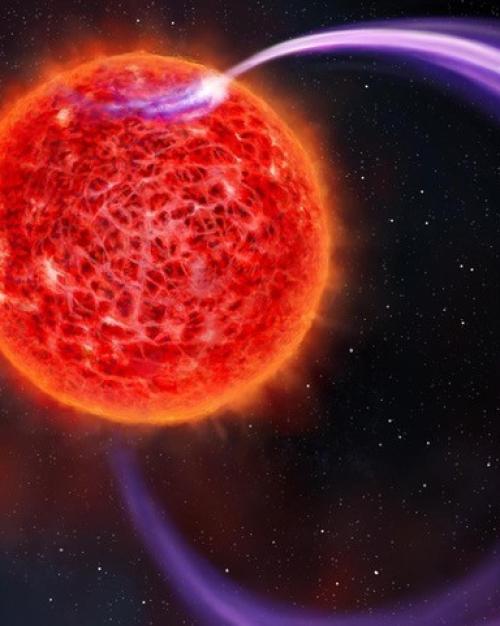
An international team including Cornell researcher Jake Turner has developed a novel analysis method capable of uncovering previously undetectable stellar and exoplanetary signals hidden within archival radio-astronomical data. Thanks to this innovation, scientists have discovered new radio bursts originating from dwarf stars and possibly from exoplanets. The analysis method, Multiplexed Interferometric Radio Spectroscopy (RIMS), found that some of the signals detected are consistent with star-planet interactions.
The results, “The detection of circularly polarized radio bursts from stellar and exoplanetary systems” were published in Nature Astronomy, on Jan. 27.
Modern radio telescopes collect colossal volumes of data; the synthesized images are used to study distant galaxies and black holes. Until now, these archives had never been used to monitor, minute by minute, the variable activity of the hundreds of stars hidden within the field of view of each observation, which is what RIMS enables. The method transforms each radio observation into a simultaneous survey of hundreds or even thousands of stars, much like a net that captures many fish where a single fishing rod would catch only one.
“RIMS exploits every second of observation, in hundreds of directions across the sky. What we used to do source by source, we can now do simultaneously,” said Cyril Tasse, researcher at the Paris Observatory and lead author of the study. “Without this method, it would have taken nearly 180 years of targeted observations to reach the same detection level.”
By applying RIMS to more than 1.4 years of data collected by the European LOFAR radio telescope as part of the large sky survey LoTSS, the team generated no fewer than 200,000 dynamic spectra from isolated stars or stars hosting exoplanets.
Among the signals revealed by RIMS are bursts consistent with violent stellar events, analogous to solar coronal mass ejections.
Even more remarkably, some signals exhibit all the expected characteristics of magnetic star-planet interactions, a mechanism comparable to that producing certain auroral emissions on Jupiter, the researchers said.
These radio signatures could represent some of the first robust evidence of magnetic star-exoplanet interactions and exoplanetary aurorae, pointing to the likely existence of exoplanet magnetospheres, said Turner, a research associate in the Cornell Center for Astrophysics and Planetary Science and a member of the Carl Sagan Institute, in the College of Arts & Sciences.
“Our results indicate that some of the radio bursts, most notably from the exoplanetary system GJ 687, are consistent with a close-in planet disturbing the stellar magnetic field and driving intense radio emission. Specifically, our modeling shows that these radio bursts allow us to place limits on the magnetic field of the Neptune-sized planet GJ 687 b, offering a rare indirect way to study magnetic fields on worlds beyond our Solar System,” Turner said.
“Exoplanets with and without a magnetic field form, behave and evolve very differently. Therefore, there is great need to understand whether planets possess such fields. Most importantly, magnetic fields may also be important for sustaining the habitability of exoplanets, such as is the case for Earth,” Turner said.
The RIMS breakthrough opens a new avenue for low-frequency radio astronomy, since RIMS effectively turns every array of radio telescopes into a powerful detector of variable radio signals from nearby stars. The new technique was successfully applied to the new French low-frequency radio telescope NenuFAR and provided the detection of a burst from a star-planet system. That paper, co-authored by Turner, was published last year in Astronomy & Astrophysics.
“This study with NenuFAR could represent only the second ever direct detection of radio emission from an exoplanet, following my earlier discovery of radio emission from Tau Boötes, which was the first such possible detection,” Turner said. “We are now pursuing targeted follow-up observations to confirm the planetary origin of both signals. A confirmed detection would provide a powerful new way to probe an exoplanet’s magnetic field.”
Future ground-based, space-based, and Lunar radio telescopes will all be able to use this new technique, Turner said, and are expected to reveal thousands of new radio signals, paving the way for large-scale statistical exploration of stellar radio emissions and star-planet interactions in our galactic neighborhood.