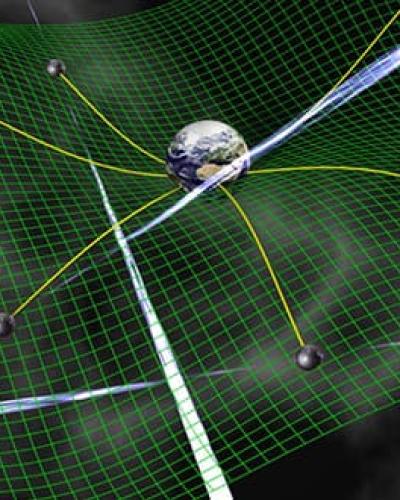
Cornell researchers are at the forefront of exoplanet science, using advanced observations and theoretical models to study the atmospheres, climates, composition and detection of planets orbiting distant stars.
Our work combines space- and ground-based observations with sophisticated multi-dimensional atmospheric modeling to understand how exoplanets form, evolve, and potentially support life. Cornell researchers play major roles in observations with the James Webb Space Telescope, which is transforming our ability to characterize alien worlds by detecting molecules such as water vapor, methane, carbon dioxide, clouds, and hazes in exoplanet atmospheres. Current projects investigate the chemistry and weather of hot giant planets, warm Neptunes, the nature of rocky super-Earths, and the atmospheres of potentially habitable terrestrial worlds, while also developing new instruments and laboratory experiments to interpret these observations and guide the future of exoplanet exploration.
Related people
All research areas
Accelerator Physics
Aesthetics & Media Studies
Algebra
Analysis
Analytical
Applied Mathematics
Astrophysics, General Relativity and Cosmology
Atmospheric Spectral Signatures
Bangla
Biogeochemistry and Ecosystem Science
Bioinorganic
Biological Physics
Biology Education Research
Bioorganic
Biophysical
Astrobiology
Burmese
Chemical Biology
Chinese (Mandarin)
Cognition
Combinatorics and Discrete Geometry
Community and Urban Sociology
Community Ecology and Population Biology
Comparative and World Literature
Comparative Media Studies
Computational Social Science
Cosmic Origins and Evolution
Critical Studies of Race, Gender & Sexuality
Critical Studies of Race, Gender, and Sexuality
Critical Theory
Culture
Development
Theoretical and Computational Astrophysics
Early Modern Studies
Economy and Society
Engaging With Life on Earth
Evolutionary Patterns and Processes
Experimental Condensed Matter Physics
Experimental Elementary Particle Physics
Exoplanets
Gender
Geometry
Habitable Environments
Hindi-Urdu
Indonesian
Inequality and Social Stratification
Inorganic
Intimate Organismal Interactions and Chemical Ecology
Japanese
Kannada